Was This Atlantis?
Examination of the possible location and the reason of its disappearance.
Version Française.
Atlantis, where was it? How many people?
Its size?
Atlantis,
where was it?
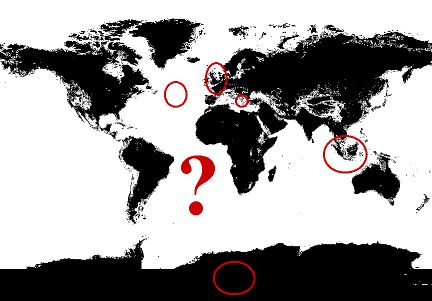 That is the question which many have already tried to
answer. There are, in fact, many scientists and non-scientists who
claim to have found Atlantis there, here or elsewhere. We can also
see that there are almost as many hits of Atlantis as centers of
interest. The first, of course, include the Greek islands, where the
island Thera, which exploded in 1500 before Christ, is the star.
Other locations often mentioned are: the coasts of Spain, the Bahamas
archipelago, the region north of the island Madeira where there is a
small ridge, the Celtic plate, under the ice of Antarctica, the
Indonesian archipelago. Among other the places is the region from
eastern Pakistan to Bangladesh, presented in a convincing manner by
Mr Radek Brychta in 2001 and which would, in his view, be identical
to the mythical country of Dilmun, also disappeared.
That is the question which many have already tried to
answer. There are, in fact, many scientists and non-scientists who
claim to have found Atlantis there, here or elsewhere. We can also
see that there are almost as many hits of Atlantis as centers of
interest. The first, of course, include the Greek islands, where the
island Thera, which exploded in 1500 before Christ, is the star.
Other locations often mentioned are: the coasts of Spain, the Bahamas
archipelago, the region north of the island Madeira where there is a
small ridge, the Celtic plate, under the ice of Antarctica, the
Indonesian archipelago. Among other the places is the region from
eastern Pakistan to Bangladesh, presented in a convincing manner by
Mr Radek Brychta in 2001 and which would, in his view, be identical
to the mythical country of Dilmun, also disappeared.
The place mentioned by Plato, which was partially confirmed by
Cayce, lies in principle in front of columns of Hercules, we now call
the Strait of Gibraltar. We can assume with a high probability that
the island Atlantis was located somewhere in the Atlantic Ocean.
Regarding its size, it was also Plato and Cayce who had a good idea
of what we should seek, and where we should look. These two
gentlemen were both speaking of a small continent, rather than an
island. Even when Cayce did not specify a size, it seems that it was
certainly not a small island. Plato gave us a little more guidance,
both direct and indirect. When Plato spoke of Atlantis in terms of
size, he had specified that the island was larger than Libya and Asia
together of his time. The size indicated by Plato was corresponding
to a size larger than North Africa (Libya) and the Middle East
(Asia) combined. We should therefore think in terms of
thousands of kilometers and millions of square kilometers. Cayce,
he, was not as precise, he spoke of an island that went from the
African coast to American coast. Another indication given by Plato
is rather an indirect indication, as he spoke of a plain two hundred
thirty by three hundred fifty kilometers, protected by mountains from
cold winds from the north. It's this plain of such a size, including
mountains, that must find its place on an island. It's, regarding
the size indicated, unlikely that an island of this size would have
found its place somewhere in the Mediterranean.
On the other hand, it's neither Plato, nor Cayce, who give us a
clue of the population, and their enumeration. Only a Maya legend
states a quantity of sixty-four million. Plato, on the other hand,
had left us with an indirect evidence in the form of the description
of the army of Atlantis. He had detailed how the plain was divided
and how many men and horses each plot had to provide for the defense
of the country.
Extract what Critias says of the military:
« ...Regarding
the number of soldiers that the plain had to provide in the event of
war, it was decided that each district had to provide a leader. The
size of the district was ten times ten stadia and there were a total
of six myriads. As for the men who lived in mountains and across the
country, their number, I was told, was infinite, and they were all
divided by localities and villages between those districts under the
authority of their leaders. But the chief was required to provide
for the army the sixth part of a war-chariot, in order to bring the
number to ten thousand, two horses and their riders, in addition a
team of two horses without a seat, with a fighter armed with a small
shield and the driver of those two horses who stood behind the
fighters, two heavy armed soldiers, two slingers, three
stone-shooters and three javelin-men, who were light-armed and four
sailors to fill twelve hundred ships. Such was the military order of
the royal city. For the other nine provinces, each had its
particular organization, whose explanation would require a lot of
time...»
Detail
of the army and the number of men from each of the military:
-
|
Number
|
Function
|
|
60 000
|
Managers
and leaders.
|
|
120 000
|
Knights,
Horseman.
|
|
60 000
|
Chariot
fighters armed with a small shield.
|
|
60 000
|
Chariot
drivers.
|
|
120 000
|
Light
infantry.
|
|
120 000
|
Heavy
infantry and archers.
|
|
120 000
|
Slingers.
|
|
180 000
|
Fighters
on foot and stone-shooters.
|
|
180 000
|
Javelin
man.
|
|
240 000
|
Sailors.
|
|
1 260 000
|
Total
number of soldiers.
|
Number of Equipments:
-
|
Number
|
Description
|
|
120 000
|
Horses
|
|
60 000
|
Hitches
for two horses.
|
|
120 000
|
Coupling
horses without a saddle.
|
|
10 000
|
Chariots
of War and Battle Chariots.
|
|
1 200
|
Warships.
|
We can see from this description, that the enumeration of the
population had to be accordingly high. There were already sixty
thousand districts of 138 hectares each, giving a total size of the
plain of 82'980 square kilometers. We should not forget that Plato
had provided details of the plain, indicating that the rest, the
people living in the mountains and elsewhere, was infinite. In
addition, a small calculation shows that each district should provide
the army twenty-one man and four horses. We must also bear in mind
that an armed militia, or conscripts, could hardly have exceeded five
percent the entire population without harming the economy. We
should, therefore, consider that a district had at least four hundred
and twenty people. Four hundred and twenty people per district
leaves us with about three people per hectare. A hectare, on the
other hand, could easily feed more people,
especially in a region allowing two crops per year. It could
therefore be estimated that the number of inhabitants per hectare, ie
those who earned their lives on working the ground and those who were
fed in an indirect way of crops, lies in the range of eight to twenty
people per hectare. It's obvious that all these people didn't live
in the plain, but that there should have been, apart from the main
city, Poseidon, other towns and villages where people lived as well.
Already the main city of Atlantis, Poseidon, had a total size
exceeding the city of Paris, bounded by the Boulevard-Périphérique,
a kilometer on each side. Plato describes that the central city of
Poseidon was surrounded by a circular area of fifty stadia (5.88 km)
wide closed by a wall with very dense construction. If we add up all
the dimensions of the city of Poseidon, we get a city with a size of
about fourteen kilometers in diameter. We can, taking into account
that the city of Paris had in 2004 about two million people, estimate
that the main city of Atlantis, Poseidon, would have had at least as
many.
Regarding the enumeration of
total inhabitants of Atlantis, we cannot estimate it with certainty.
On the other hand the figures we can infer from the description of
Critias, concern only the people of the plains and the main city.
However, the plain had already at least, multiplying
sixty thousand by four hundred and twenty, roughly twenty-five
million people. An interesting aspect is the relationship between
the enumeration of the population who lived in the plains and the
estimated number we could find in town. We can therefore estimate
that ninety-two per cent of the population lived in the countryside,
as this was the case in Europe in the 19th century.
We can estimate, taking into account that Plato didn't mention
anything about people who lived in the mountains, or those who lived
in the nine other states that Atlantis was composed of, that the
enumeration of the Atlantean population should be a hundred million
at least. What is interesting is that some pre-Columbian societies
spoke in their myths of a distant country with sixty-four million
people, which remains quite close to those estimates.
What do the dialogues of Plato say about the location and size of
Atlantis?
Quote from Critias compared to the exploits of the Athenians:
« ...Indeed,
the written monuments say your city once destroyed an immense power
that walked insolently on Europe and Asia as a whole, from another
world located in the Atlantic Ocean. You could then cross the ocean,
because an island could be found there in front of this strait that
you call, as you say, the columns of Hercules. This island was
larger than Libya and Asia combined. From this island we could then
move to other islands and then gain the whole continent that extends
in front of them as the real border. Because everything that is
inside the strait we are talking about looks like a port with a
narrow entrance, while that which is beyond form a sea and the land
that it surrounds, may be most truly called a boundless
continent... »
At first glance, we can see that there is question of a small
continent, which is at the center of an ocean. This ocean apparently
was formerly called as now, the Atlantic Ocean. Then to give weight
to his example, the Egyptian priest who had narrated it to Solon, had
compared the Mediterranean Sea with a sea port so small it was
vis-à-vis the ocean. (True!) We can also observe that we
could cross the ocean, from the columns of Hercules to the island
which was opposite of it. In addition, they mention that we could
win from that island, Atlantis therefore, other islands. Then from
these other islands we could win the whole continent that stretched
in front of them and bordered this true ocean. Although Plato's
intention was to praise the exploits of the Athenians at the time,
gave us nevertheless good idea of the size and where Atlantis would
be found.
The facts mentioned by Plato stick quite well with reality; the
figures seem also to stick quite well. So we see that these facts
and figures also stick with a small continent that had to be the size
of one to two times the European union of fifteen. It's therefore
unnecessary to correct the data of Plato and search anything,
anywhere, just look for the right thing at the right place, it's that
easy!
|